Sakura Haiku Challenge 2026
2026/2/18
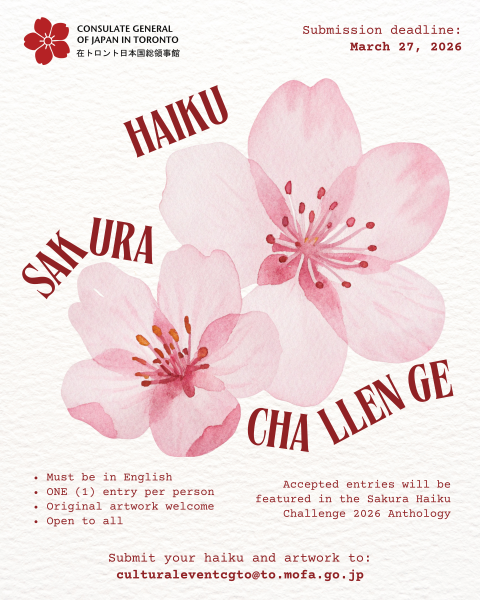
The Consulate-General of Japan in Toronto is proud to announce the opening of our 4th annual Sakura Haiku Challenge. We are now accepting submissions under the theme, “Sakura” (Japanese cherry blossoms).
Submission Period: February 18 to March 27, 2026
Apply by e-mail: culturaleventcgto@to.mofa.go.jp
Subject line: Sakura Haiku Challenge 2026 – (Your name, initials or pen name)
Subject line: Sakura Haiku Challenge 2026 – (Your name, initials or pen name)
Guidelines & Eligibility
- Open to everyone worldwide and of all ages
- ONE(1) entry per person
- Must be in English
- A three-line poem is preferred
- Include a seasonal reference (kigo) related to cherry blossoms (sakura)
- No 5–7–5 syllable requirement
- Must be an original piece of work by the entrant
- Artwork or photographs are welcome and must be originals created by the entrant (AI artwork will not be accepted)
- Entries with vulgar, offensive, or sensitive content will not be accepted. We will review every submission and retain the right to disqualify any materials we deem inappropriate for our social media, website, or other publications.
How to submit
Please complete and send the following information with your submission. Attach your artwork/photograph related to your haiku if applicable. (NOTE: Image files must not exceed 8MB in size.)
1. Full Name
2. If your haiku is approved, do you give us (the Consulate-General of Japan in Toronto) permission to post it on our social media platforms (Facebook, Instagram, and X)?
☐ Yes
☐ No
3. Do you give us permission to publish your full name?
☐ Yes
☐ No (Please specify your preferred credentials) ____________________
4. Do you understand and agree with the Guidelines and Eligibility?
☐ Yes
☐ No
5. Which Country (or Province, Territory, State) are you from?
6. How did you learn about this event?
☐ Consulate website
☐ Consulate Facebook
☐ Consulate Instagram
☐ Consulate X
☐ Other: ____________________
*** Approved entries will be:
Posted on our social media platforms (Facebook, Instagram, and X)
Collected and compiled into a 2026 electronic anthology
Information on Haiku
What is Haiku?
Haiku originated in Japan and is the world’s shortest form of poetry. Haiku uses simple yet poignant expressions of imagery and conventionally requires the use of Kigo, a word associated with a particular season.
Haiku began as Hokku, the opening stanza of linked poems called Renga. Around the time of the famed poet Matsuo Bashō (1644–1694), Hokku began to appear as a separate, independent form of poetry. This distinct form of Hokku was renamed Haiku in the late 19th century.
Although a traditional Japanese Haiku consists of three lines containing 17 syllables in total (divided as 5-7-5), we do not require this structure for the challenge. However, since Haiku is conventionally defined by its short length, three-line poems are desirable.
If you have any questions, please feel free to send us an email at culturaleventcgto@to.mofa.go.jp
Haiku originated in Japan and is the world’s shortest form of poetry. Haiku uses simple yet poignant expressions of imagery and conventionally requires the use of Kigo, a word associated with a particular season.
Haiku began as Hokku, the opening stanza of linked poems called Renga. Around the time of the famed poet Matsuo Bashō (1644–1694), Hokku began to appear as a separate, independent form of poetry. This distinct form of Hokku was renamed Haiku in the late 19th century.
Although a traditional Japanese Haiku consists of three lines containing 17 syllables in total (divided as 5-7-5), we do not require this structure for the challenge. However, since Haiku is conventionally defined by its short length, three-line poems are desirable.
If you have any questions, please feel free to send us an email at culturaleventcgto@to.mofa.go.jp